Course Details
| Duration | 30 scheduled hours |
|---|---|
| Sessions | 15 sessions × 2 hours (1 hour 45 minutes of instruction and practice, plus a 15-minute break) |
| Delivery Mode | In-Person |
| Course Type | Short Course / Practical |
| Credential | NorthBridge Academy Certificate of Completion |
About This Course
This hands-on introductory course develops foundational skills for assisting with the installation of common household appliances. Participants learn worksite assessment, tool use, manufacturer instructions, basic electrical and plumbing awareness, levelling and securing appliances, testing, documentation, customer communication, and safe troubleshooting. Training is limited to non-regulated introductory tasks and simulations; electrical, gas, refrigeration, or plumbing work requiring a licensed trade must be referred to appropriately qualified professionals.
Learning Objectives
Target Audience
Delivery & Assessment
Delivery and learning methods: Instructor-led presentations, guided discussion, demonstrations, case studies, individual and group exercises, role-play or simulations, applied assignments, structured feedback, and a final practical or integrative activity appropriate to the subject area.
Assessment: Safety and knowledge checks 20%; tool-use demonstrations 20%; installation simulations 35%; documentation and customer handover 10%; final practical project 15%.
Certificate requirements: Minimum 80% attendance, completion of required learning activities and assessments, and a minimum overall grade of 70%. The certificate identifies the course title and scheduled duration and does not represent a licence, regulated credential, diploma, or guarantee of employment.
Required materials and technology: Work clothing, safety footwear, safety glasses, gloves, tape measure, basic hand-tool kit, and manufacturer manuals supplied or approved by the instructor.
Course Outline
Roles in appliance delivery, installation, service, and repair; major appliance categories; customer and employer expectations.
Learning objectives: Identify appliance categories; describe entry-level roles; recognize professional expectations.
PPE, lifting hazards, sharp edges, electricity, water, gas, confined spaces, and stop-work decisions.
Learning objectives: Select basic PPE; identify hazards; recognize when work must stop or be referred.
Hand tools, drivers, levels, measuring, anchors, fasteners, tool inspection, and storage.
Learning objectives: Choose appropriate tools; measure accurately; maintain tools safely.
Model identification, specifications, clearances, installation diagrams, warranties, and documenting compliance.
Learning objectives: Interpret manuals; verify clearances; document installation requirements.
Access routes, floor protection, utilities, cabinet openings, appliance condition, and confirming scope with customers.
Learning objectives: Conduct a site check; identify constraints; confirm scope and exclusions.
Team lifting, dollies, straps, floor protection, unpacking, inspection, and damage prevention.
Learning objectives: Plan safe movement; use handling aids; prevent property and product damage.
Voltage labels, grounded outlets, cord inspection, disconnect awareness, and tasks reserved for licensed electricians.
Learning objectives: Recognize basic electrical requirements; identify unsafe conditions; refer regulated work.
Supply hoses, shut-off valves, drainage, leak prevention, and plumbing referral boundaries.
Learning objectives: Identify water connections; apply leak-prevention checks; refer plumbing deficiencies.
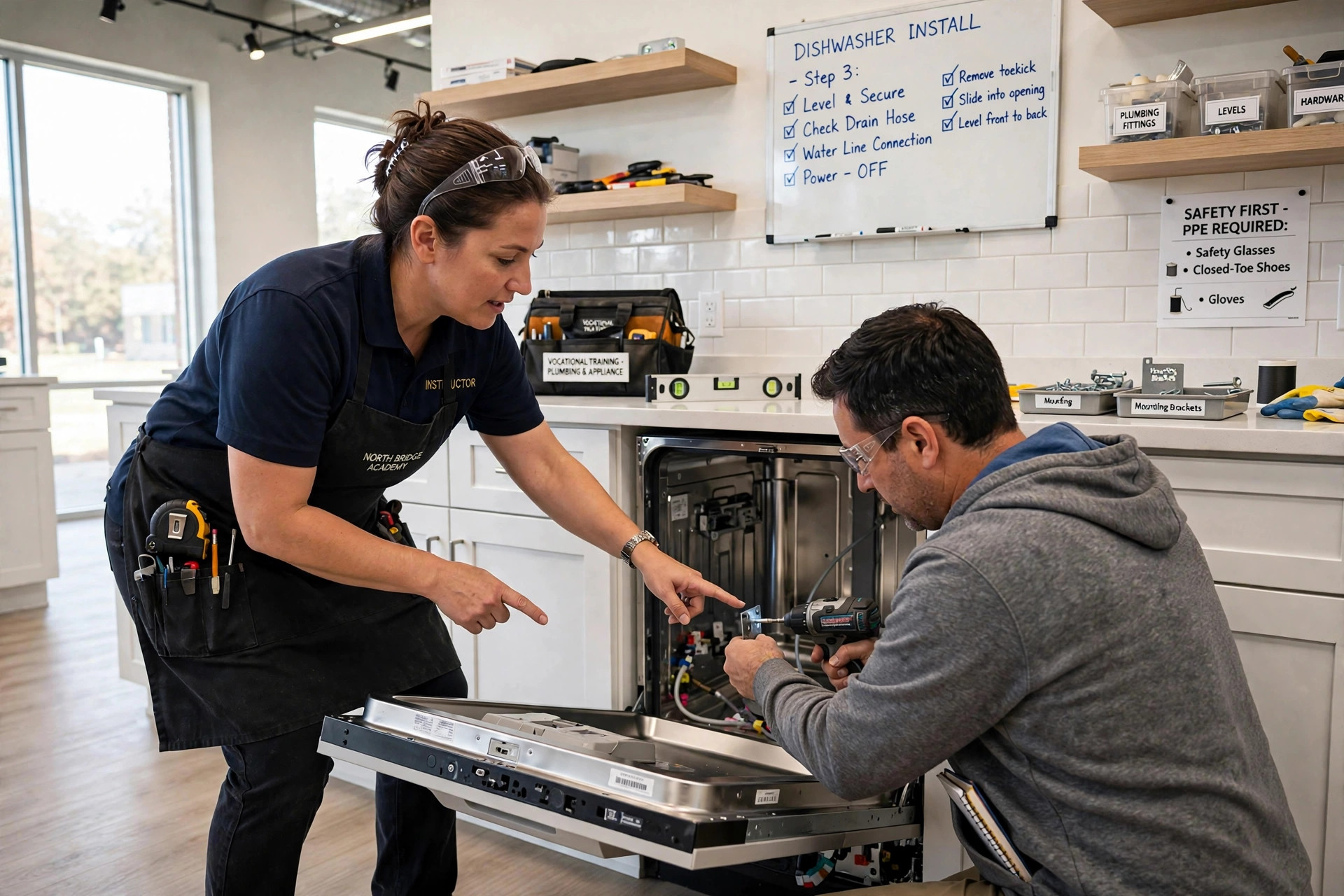
Opening measurements, levelling, securing, drain routing, water and power awareness, and test procedures in a training environment.
Learning objectives: Sequence a dishwasher installation; level and secure equipment; complete test checks.
Washer hoses, drain setup, levelling, dryer venting awareness, stacking requirements, and customer handover.
Learning objectives: Set up laundry appliances; recognize venting risks; perform basic operational checks.
Clearances, levelling, door alignment, water-line awareness, transportation timing, and customer instructions.
Learning objectives: Position and level refrigerators; identify water-line referral needs; explain startup precautions.
Anti-tip devices, clearances, electrical and gas hazards, and strict referral requirements for regulated connections.
Learning objectives: Recognize anti-tip requirements; identify regulated tasks; refuse unsafe or unauthorized work.
Microwaves, wall ovens, range hoods, mounting considerations, cabinetry, ventilation, and licensed work interfaces.
Learning objectives: Identify specialty requirements; assess mounting risks; coordinate with qualified trades.
Visual inspection, levelling, leak checks, vibration, error codes, documentation, and distinguishing installation from repair issues.
Learning objectives: Perform basic quality checks; isolate common setup issues; refer repair faults.
Integrated installation simulation, safety review, customer handover, invoice/work-order basics, and next-step employment planning.
Learning objectives: Demonstrate a safe installation workflow; complete handover documentation; create a career action plan.
Scope & Limitations
Introductory and non-licensing. The course does not authorize regulated electrical, gas, refrigeration, or plumbing work and does not guarantee trade certification or employment.
In practice, the course covers positioning appliances and plugging them into existing outlets only — no electrical, plumbing, or gas connections are performed.
Course dates will be announced soon. To pre-register your interest in Appliance Installation Basics or to ask about upcoming sessions, contact the academy — we would love to hear from you.